
Web app DAST built for modern applications.
Modern apps are single-page, JavaScript-heavy, and form-heavy. NightVision drives a real browser and tests the app fully authenticated.
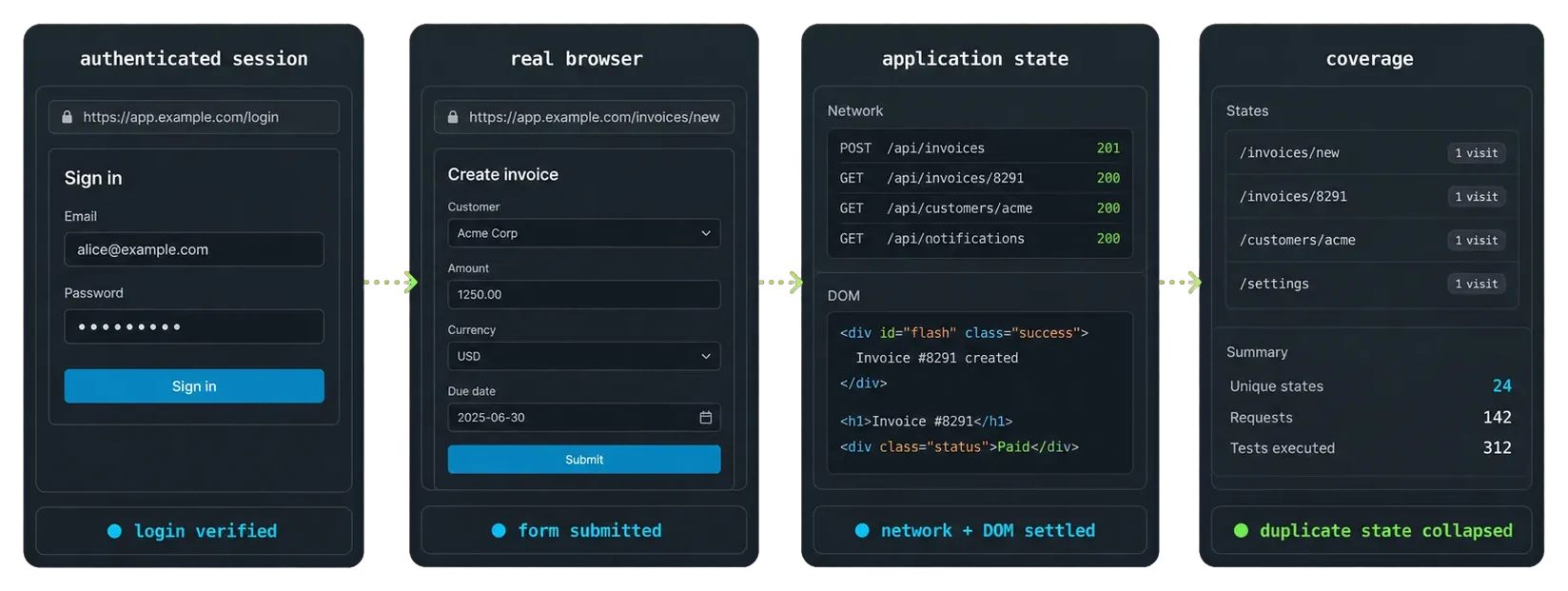
How the crawler is different
Three mechanisms separate NightVision from a link-following spider.
Forms get filled, not abandoned
Each rendered form is filled with valid, internally consistent values, so validation-gated submits fire the underlying API.
Pages tested when actually ready
No fixed timers: the crawler watches network and DOM mutation events over WebDriver BiDi and advances only when both quiesce.
Large apps stay scannable
DOM, URL, and action signatures collapse templated pages to one logical state, so scan budget goes to genuinely distinct surface.
Built for the apps you actually ship
Real browser, real routes, real state
React, Angular, and Vue apps are driven in a real browser. A plain HTTP fetch sees an empty <div id="root">; NightVision sees the application.
Test the fully authenticated app
Record your login once as a Playwright script: credentials vault automatically, TOTP-based MFA runs at scan time, and the session is verified first. How authenticated scanning works →
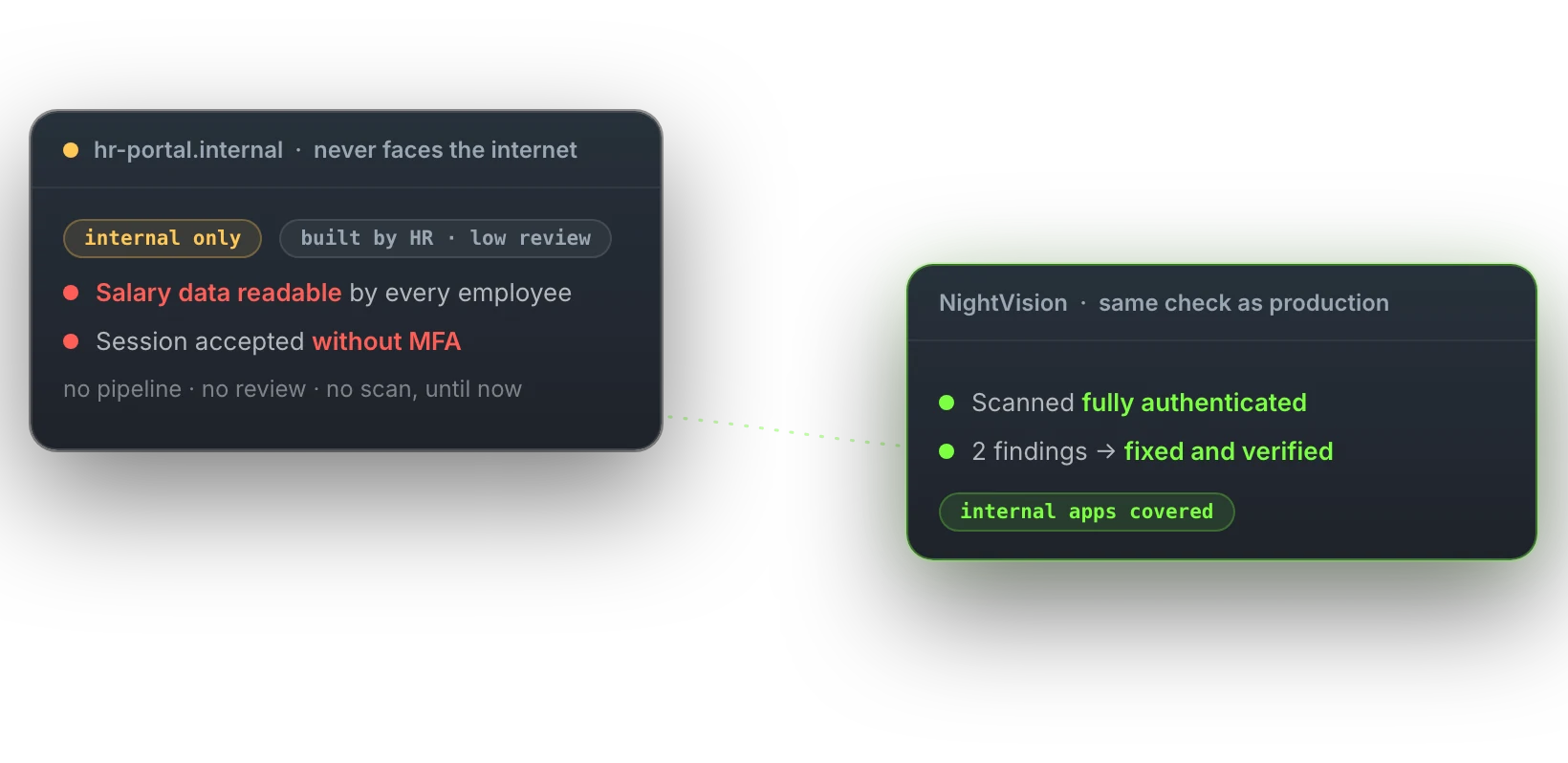
Internal apps without infrastructure changes
The Smart Proxy reaches internal, pre-production, and network-segmented apps: no agents, no appliances, no routing changes. Private network scanning →
The endpoints your traffic never shows
OpenAPI specs generated from source in under 20 seconds add documented and shadow routes to the same dynamic testing workflow. API discovery from source →
Findings developers act on, not tickets they dispute
Runtime evidence behind the finding
Request-level findings retain the relevant HTTP exchange, can produce a curl reproduction, and export as SARIF into GitHub Security Alerts.
Endpoint source context where supported
On supported API scans backed by source discovery, findings resolve to the defining file and line for fix and rescan before review. AI-assisted remediation →
That determinism makes NightVision findings safe inputs for coding agents via MCP. See how NightVision is agent-ready →
Traffic-based DAST vs. NightVision
Approaches, not vendors. Evaluating a specific tool? See the comparison hub: vs Burp Suite, vs Invicti, vs StackHawk.
| Capability | Traditional traffic-based DAST | NightVision |
|---|---|---|
| SPA / JavaScript-rendered coverage | ⚠️ Partial, or static HTML only | ✅ Real browser, routes followed |
| Validation-gated forms | ❌ Abandons at required fields | ✅ LLM form handling completes the flow |
| Authenticated scanning | ⚠️ Often breaks silently at login | ✅ Recorded login, TOTP/MFA, login-check gate |
| Internal / private-network apps | ⚠️ Agents or appliances required | ✅ Smart Proxy, zero infrastructure changes |
| Undocumented API coverage | ❌ Only endpoints seen in traffic | ✅ OpenAPI specs generated from source |
| Finding evidence | ⚠️ Alert with a payload | ✅ Full request/response; file:line on supported source-discovered API findings |
Web app DAST questions, answered.
What is DAST?
Dynamic Application Security Testing tests a running application from the outside, sending real requests and analyzing responses to find vulnerabilities like SQL injection, XSS, and authentication flaws. NightVision adds source awareness: request-level findings retain the HTTP exchange, and supported source-discovered API findings can tie back to the defining file and line.
Can NightVision scan single-page applications?
Yes. The crawler drives React, Angular, and Vue apps in a real browser, follows client-side routes, and advances only when network activity and DOM mutations have settled, so dynamically rendered content is fully loaded before testing.
Does NightVision scan fully authenticated?
Yes. Record your login once as a Playwright script; credentials are extracted to a secrets vault automatically, and NightVision scans as a signed-in user, TOTP-based MFA included. A login-check gate fails the pipeline if authentication did not succeed.
See NightVision cover the app your current scanner is missing.
Start free and run your first authenticated scan. SOC 2 Type 2 (report available under NDA).